
Re-Post Friday
If God calls you to do something, how will you respond?
Today we look back on why Mill House Ministries began. Read it HERE!

A Strange Direction
How do you react when God asks you to do something that seems impossible?

It is no doubt that we are faced with choices when we follow God. Some of His directions are easy to do, some are harder and require a more active focus to complete. However, often it seems as if these are the only two ways that God’s direction occurs for the believer. It is either an easy choice to follow or a challenge. But what about the directions that may seem impossible or even ridiculous? One such example comes to mind and can be found in Joshua 6.
“ Now Jericho was tightly shut because of the sons of Israel; no one went out and no one came in. 2 But the Lord said to Joshua, “See, I have handed Jericho over to you, with its king and the valiant warriors. 3 And you shall march around the city, all the men of war circling the city once. You shall do so for six days. 4 Also seven priests shall carry seven trumpets of rams’ horns in front of the ark; then on the seventh day you shall march around the city seven times, and the priests shall blow the trumpets. 5 It shall be that when they make a long blast with the ram’s horn, and when you hear the sound of the trumpet, all the people shall shout with a great shout; and the wall of the city will fall down flat, and the people shall go up, everyone straight ahead.””
Joshua 6:1-5
God’s people were told to walk around a city in a circle for seven days, if they did this then after the seventh day the city would be handed over to them. To anyone else, this command might seem as if God was attempting to make a mockery out of His people. How could simply walking bring down a wall? And yet, through their faith that God would hold to His promise, Joshua and the people followed through with this strange direction.
If you are not familiar with this event, the result can be found in Joshua 6:20, “So the people shouted, and the priests blew the trumpets; and when the people heard the sound of the trumpet, the people shouted with a great shout, and the wall fell down flat, so that the people went up into the city, everyone straight ahead, and they took the city.”
The people had nothing to go off of except for the fact that God upholds His promises, even the strange ones that at the time seem as if they will result in nothing. So why is this reminder important? While we might not be asked to walk around a city, God may still be leading us in strange paths. What He wants us to do, might seem impossible. If you are faced with God asking you to do something that seems as if it is impossible, I ask that you remember this event. If God can bring down a wall, He will accomplish the task He has set before you. All you need to do is keep moving and see how God will uphold His promise!
Seek the truth and encourage one another,
Alex

A Christmas Publication
Wondering about the best way to prove the Holy Spirit can use man to write the Bible? Look at the perfect life and birth of Jesus Christ.

Last week we went over how the Holy Spirit could be considered the most quoted God-Head in the Bible, because of His involvement developing the Holy Scriptures. While there are several wonderful topics regarding the Holy Spirit, His reality, His role in the Trinity, His role with Man kind, and many others; today we are specifically looking at His role in regards to the creation of God’s written Word. Ironically, the best evidence of His role is actually found in His involvement with Christ’s birth. It should be noted that some scoffers who doubt the capability for the Holy Spirit to use man to write the Bible fail to recognize the full and tangible example of this being displayed in the work of the Holy Spirit about to bring Jesus Christ as a God-Man. The Holy Spirit uses Jesus Christ’s birth as a living example of what He was doing with the publication of His written word. When you evaluate the necessary actions for both, you can compare the similarities and see how Christ’s birth was a declaration of the Holy Spirit’s ability to be more than most understand and appreciate. Christ’s birth reveals the Holy Spirit’s ability to overshadow mankind for the creation of His perfect, pure, and unalterting Word. This is further expounded upon when Jesus Christ claims to be the Word of God! Christ’s perfection validates the Bible’s inerrancy which in turn validates the Holy Spirit’s role.
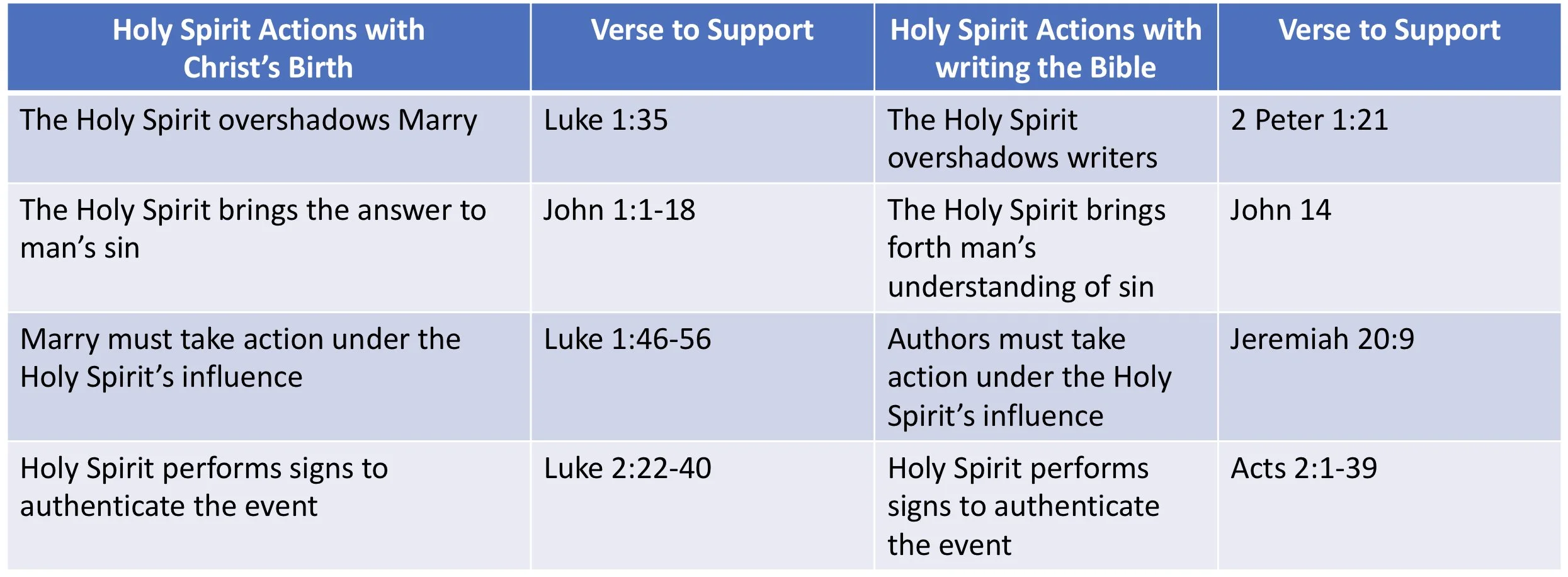
Some might argue symantec’s of the words “overshadow” or “guidance” but this only identifies limitations of man’s vocabulary within written languages rather than God’s capacity to properly utilize man and Himself in writing His scripture. While creation exhibits God’s existence, His Word exhibits the Holy Spirit’s role as being His true and only word. For those who might say God had to write the entire word and man had no part, I would point once again to how Christ came about. He was indeed a blood relative of Mary and an ancestor to King David, thus physically influenced. In comparison, the different books of the Bible each have their own unique characteristic of those who “penned” the book. The Holy Spirit appears to thrive on bringing out our unique attributes to set forth His perfect craftsmanship, in this case both the Holy scripture and the Son of God.
So as we celebrate the Christmas season, know that Christ’s birth also exemplifies the power of the Holy Spirit to bring about a completed message from God Himself to you and I, the sixty-six books of the Bible. I hope you have enjoyed this small study into a rather marvelous role of the Holy Spirit. I would encourage you to look into the scripture identified in the table and see where else God proclaims His roles in His word and in your life! We have a wonderful God in the Holy Spirit who brought to us not only His scripture, but also a living breathing Son of God who died and rose again for you and I. Let us not take this with indignant hearts, but rather meditate and ask the Holy Spirit to continue to teach us and reveal more of His master piece in His written word and in His final revelation in Jesus Christ.
Hold until relieved, our Blessed Hope is coming
JL

Re-Post Friday
How do your actions reflect your belief?

A review of the breastplate of righteousness and the importance it has! Read it HERE!

A Living Faith
Concluding James chapter 2 with a comparison of a living faith.

We have now come to the end of James chapter two. Just as James makes sure to cause the reader to reflect on their faith, he also wants to leave them with an encouragement. That is why in the second half of this chapter, James leaves his brothers and sisters in Christ an example of what a true and living faith is.
“20 But are you willing to acknowledge, you foolish person, that faith without works is useless? 21 Was our father Abraham not justified by works when he offered up his son Isaac on the altar? 22 You see that faith was working with his works, and as a result of the works, faith was perfected; 23 and the Scripture was fulfilled which says, “And Abraham believed God, and it was credited to him as righteousness,” and he was called a friend of God. 24 You see that a person is justified by works and not by faith alone. 25 In the same way, was Rahab the prostitute not justified by works also when she received the messengers and sent them out by another way? 26 For just as the body without the spirit is dead, so also faith without works is dead.“
James 2:20-26
Last week we discussed that a dead faith is one that provides no fruit of a changed life. The person continues to behave the same way as before they “professed” to know Christ. Now James offers a comparison of what a living and fruitful faith is by providing two examples. James begins with Abraham. To understand the magnitude of James remarks about Abraham, I ask that you go back and read Genesis 15. In this chapter God makes a promise that Abraham’s descendants will be as numerous as the stars (Genesis 15:5). At the time, Abraham was childless and believed that he would not have any children. Yet God would later provide Abraham two sons. For the purposes of this post, we are going to focus on Abram’s second son, Isaac who the promise that God made Abraham was intended for.
Now I would ask you to go and read Genesis 22. In this chapter we see that Abraham is being tested by God. Abraham is asked to go and sacrifice his son, Isaac. We see a hint of Abraham’s faith in verse 5, “5 Then Abraham said to his young men, “Stay here with the donkey; I and the boy will go over there and worship and come again to you.” Abraham knew what was being asked of him, and yet he still told and believed that both he and his son would return to the men. This faith continued even up to the point that he nearly sacrificed Isaac (Genesis 22:10). Abraham did not know how God would uphold His promise if Isaac was killed, and yet Abraham submitted wholly to the will of God. He showed his faith by his willingness to listen to God.
The second example that James provides of a living faith is that of Rahab. To understand how Rahab lived I ask that you read Joshua chapter 2. The first thing to note here, is that Rahab is not Jewish. In fact, considering she identified as a harlot (Joshua 2:1) she is the last person that many would assume to have a life changing faith in God. Yet this woman had heard of God and knew that He has authority in heaven and on earth (Joshua 2:11), she recognized God’s authority and through her faith that God’s servants would keep their promise to her, she assisted them in escaping. Rahab’s story continues in Joshua 6 were we see that all of her city was destroyed except for her family and their home (Joshua 6:17).
Through both Abraham and Rahab, as well as the others that are mentioned in Hebrews eleven which I highly encourage you to read for encouragement, we see that a true faith in Jesus Christ results in a changed life. We do not remain the same as we were before we accepted Jesus as Lord and Savior, through the Holy Spirit we produce fruit. It is through the fruit of our works that we are then identified by others as followers of Jesus Christ. I ask you to look back now through your own walk with Christ, are you simply going through the motions and living out a dead faith? Or is your faith producing works that point others to the Man who came to serve others, Jesus Christ?
Seek the truth and encourage one another,
Alex

Not So Hidden Author
I bet you don’t know who is the most quoted part of the Trinity in the Bible.

Not too long ago, I was doing my Bible study and I had a thought come across my mind regarding the Trinity (God the Father, God the Son, and God the Spirit). I asked myself, who do we hear from the most in the Bible? Some might say it is God the Father, but when you compare the quotes in the Old Testomant to the Christophenies (Preincarnated appearing of Jesus Christ) you quickly realize this is not possible. Yet, some might say it is God the Son, due to Jesus is quoted not only in the Gospels John 21:24-25 “24 This is the disciple who testifies of these things, and wrote these things; and we know that his testimony is true. 25 And there are also many other things that Jesus did, which if they were written one by one, I suppose that even the world itself could not contain the books that would be written. Amen” but also in the Old Testament and other New Testament books.
We know that Jesus is the representation of the Trinity to man, John 14:7-11 7 “If you had known Me, you would have known My Father also; and from now on you know Him and have seen Him.” 8 Philip said to Him, “Lord, show us the Father, and it is sufficient for us.” 9 Jesus said to him, “Have I been with you so long, and yet you have not known Me, Philip? He who has seen Me has seen the Father; so how can you say, ‘Show us the Father’? 10 “Do you not believe that I am in the Father, and the Father in Me? The words that I speak to you I do not speak on My own [authority;] but the Father who dwells in Me does the works. 11 “Believe Me that I [am] in the Father and the Father in Me, or else believe Me for the sake of the works themselves.” We know that the entire redemption story is written around Jesus Christ. However, when it comes to Jesus being quoted, we do not have as much as our final choice.
The Holy Spirit! The Holy Spirit, is the most quoted author of the Bible. You might be wondering or even scratching your head about this, but take a moment and think about the implications of those who did write the Bible. Moses wrote Genesis and yet lived over 400 years after the last events in the book. Is Moses the one writing? Of course he is, but so is the Holy Spirit. 2 Peter 1:19-21 “19 So we have the prophetic word made more sure, to which you do well to pay attention as to a lamp shining in a dark place, until the day dawns and the morning star arises in your hearts. 20 But know this first of all, that no prophecy of Scripture is a matter of one’s own interpretation, 21 for no prophecy was ever made by an act of human will, but men moved by the Holy Spirit spoke from God.”
Peter is establishing a monumental truth that was already in practice with the coauthors of the Bible. None of them “willed” what was being written, they were all writing with inspirations of the Holy Spirit. This is a complicated aspect which we will be discussing in greater detail next week, but for now we can summarize that the Holy Spirit is talking. Jesus even recognizes this special role in John 14:26 “But the Helper, the Holy Spirit, whom the Father will send in My name, He will teach you all things, and bring to your remembrance all things that I said to you.”
In the Old Testament we see that it is the Holy Spirit once again that moves people to speak on aspects they did not see. Moses with the book of Job, David with much of Psalms, and many more. So as you go in your own Bible study, take appreciation on what God is doing as the Holy Spirit and His personal interaction daily with us. Next week we will discuss more about how the Holy Spirit does what He does.
Hold until relieved, our Blessed Hope is coming,
JL

Re-Post Friday
We look back at an issue that is still prevelent now.
Today we take a look back at the greatest injury a Christian has. Read it HERE!

A Dead Faith
Actions speak louder than words. What do yours say about your faith?
There has been a long going discussion that has transcended centuries, nations, and peoples, many have observed those who claim to be Christians and inspected the individual’s actions in hopes of identifying an authentic child of God verse imitators. Actions define the person, we identify those breathing air and capacity to utilize their senses as living people. Conversely when we are not able to breathe and our senses are not operating we are classified as dead. Actions, negative or positive, will help identify the state of the person. James captures this basic human understanding and helps identify the spiritual similarity. Wanting the Jewish Christians to understand this foundational truth, he paints a picture of two types of faith found in James chapter two.
“14 What good is it, my brothers and sisters, if someone claims to have faith but has no deeds? Can such faith save them? 15 Suppose a brother or a sister is without clothes and daily food. 16 If one of you says to them, “Go in peace; keep warm and well fed,” but does nothing about their physical needs, what good is it? 17 In the same way, faith by itself, if it is not accompanied by action, is dead. 18 But someone will say, “You have faith; I have deeds.” Show me your faith without deeds, and I will show you my faith by my deeds. 19 You believe that there is one God. Good! Even the demons believe that—and shudder.
Keep in mind, that at the time of this writing many were still with the belief that they needed to commit acts in order to be seen as righteous by God. James takes it upon himself to argue against this belief by pointing out two different types of faith. This week we will be discussing the first identified type of faith known as dead faith.
This is someone who sees the suffering of those around them and does nothing. It is the person James is describing in verses 15-16 “15 Suppose a brother or a sister is without clothes and daily food. 16 If one of you says to them, “Go in peace; keep warm and well fed,” but does nothing about their physical needs, what good is it? ” This type of faith is seen in those “Christians” who have the head knowledge of Christianity. They know the scripture and can give all of the Sunday school answers, but when it comes down to it their walk in the world does not match up to what they profess to believe. Jesus would describe this type of faith as being a whitewashed tomb, “27 “Woe to you, scribes and Pharisees, hypocrites! For you are like whitewashed tombs which on the outside appear beautiful, but inside they are full of dead men’s bones and all uncleanness. 28 So you too, outwardly appear righteous to people, but inwardly you are full of hypocrisy and lawlessness.” Matthew 23:27-28
A “faith” that does not respond to others is a dead faith. Our works cannot save us, however, it is by our works that we show evidence of a changed life when we come to Christ. Those of us who have submitted to God for salvation understand that it is out of love for us that Christ died for our sins. Therefore, faith will produce works out of love as argued in Galatians 5:5b, “ The only thing that counts is faith expressing itself through love.” And again in 1 John 3:17-18, “17 But if anyone has the world's goods and sees his brother in need, yet closes his heart against him, how does God's love abide in him? 18 Little children, let us not love in word or talk but in deed and in truth.” A dead faith will not produce fruit, a person with a dead faith will not care about those around them. They will sit in the service nodding along with the sermon but in the world they will not have the fruit of the spirit, “22 But the fruit of the Spirit is love, joy, peace, patience, kindness, goodness, faithfulness, 23 gentleness, self-control; against such things there is no law.” Galatians 5:22-23
James likens the dead faith to that of the demons“19 You believe that there is one God. Good! Even the demons believe that—and shudder.” When demons were confronted by Jesus, they often stated a fact that many people today fail to admit to. That Jesus is the Son of God, “2 When Jesus got out of the boat, a man with an impure spirit came from the tombs to meet him…6 When he saw Jesus from a distance, he ran and fell on his knees in front of him. 7 He shouted at the top of his voice, “What do you want with me, Jesus, Son of the Most High God? In God’s name don’t torture me!” 8 For Jesus had said to him, “Come out of this man, you impure spirit!”” Mark 5:2-8
While demons have the knowledge that there is God the Father, God the Son, and God the Spirit, this does not mean that they are saved. After all, the demons believe in God but they do not serve Him. A dead faith is much the same, someone who has the knowledge of God but does not produce the works expected by a changed life.
We now have a better understanding of what it means to have a dead faith. James is a book that is designed to cause the reader to reflect upon their walk with God. If you are one who is simply going through the motions, I regret to inform you that your faith is that of one who does not have a living relationship with Jesus Christ. It is telling that even demons have a greater faith than one such as this. However, there is still time! You can come before Christ and accept Him as your Lord and Savior, that no works by yourself can save you. Only the works of Jesus Christ! If you ask Him to come into your life and change it, watch how quickly He does just that! Then join us next week as we look at two individuals who have that changed living faith in Jesus Christ.
Seek the truth and encourage one another,
Alex

Just a comment…?
When Jesus makes a comment, it is worth paying attention to.
Today I want to connect some dots and help you see a remarkable truth about the Bible. The gospels are full of Jesus making doctrinal foundations that later are expounded on by the disciples. This is important to understand so that you can see how Jesus will make a comment and, in doing so, bring out a massive truth that will define a theological mountain. A great example of this is found actually in John chapter 4. In short, Jesus travels through Samaritan country and has a rather remarkable discussion. This discussion with the Samaritan woman establishes a characteristic of the Church before it was announced.
John 4:19-26 “19 The woman said to Him, “Sir, I perceive that You are a prophet. 20 “Our fathers worshiped on this mountain, and you [Jews] say that in Jerusalem is the place where one ought to worship.” 21 Jesus said to her, “Woman, believe Me, the hour is coming when you will neither on this mountain, nor in Jerusalem, worship the Father. 22 “You worship what you do not know; we know what we worship, for salvation is of the Jews. 23 “But the hour is coming, and now is, when the true worshipers will worship the Father in spirit and truth; for the Father is seeking such to worship Him. 24 “God [is] Spirit, and those who worship Him must worship in spirit and truth.” 25 The woman said to Him, “I know that Messiah is coming” (who is called Christ). “When He comes, He will tell us all things.” 26 Jesus said to her, “I who speak to you am [He.]”
She wants to know where we should worship, and Jesus rightfully brings the discussion to the source. He first identifies that the Jewish laws set down by Moses were correct, but that a day was coming when people would worship by the Spirit. He leaves the location purposefully vacant. In doing this, He foreshadows an intrinsic characteristic of the Church; we are everywhere and anywhere at any time. There is no place that the Gospel of God cannot reach, no place that the Church is off limits to go and proclaim God’s good news. Jesus later would expound on this with:
Matthew 28:18-20 “18 And Jesus came and spoke to them, saying, “All authority has been given to Me in heaven and on earth. 19 “Go therefore and make disciples of all the nations, baptizing them in the name of the Father and of the Son and of the Holy Spirit, 20 “teaching them to observe all things that I have commanded you; and lo, I am with you always, [even] to the end of the age.” Amen.”
Mark 16:15-16 “15 And He said to them, “Go into all the world and preach the gospel to every creature. 16 “He who believes and is baptized will be saved; but he who does not believe will be condemned.”
Luke 24:44-48 “44 Then He said to them, “These [are] the words which I spoke to you while I was still with you, that all things must be fulfilled which were written in the Law of Moses and [the] Prophets and [the] Psalms concerning Me.” 45 And He opened their understanding, that they might comprehend the Scriptures. 46 Then He said to them, “Thus it is written, and thus it was necessary for the Christ to suffer and to rise from the dead the third day, 47 “and that repentance and remission of sins should be preached in His name to all nations, beginning at Jerusalem. 48 “And you are witnesses of these things.
Acts 1:4-8 “4 And being assembled together with [them,] He commanded them not to depart from Jerusalem, but to wait for the Promise of the Father, “which,” [He said,] “you have heard from Me; 5 “for John truly baptized with water, but you shall be baptized with the Holy Spirit not many days from now.” 6 Therefore, when they had come together, they asked Him, saying, “Lord, will You at this time restore the kingdom to Israel?” 7 And He said to them, “It is not for you to know times or seasons which the Father has put in His own authority. 8 “But you shall receive power when the Holy Spirit has come upon you; and you shall be witnesses to Me in Jerusalem, and in all Judea and Samaria, and to the end of the earth.”
These commandments make Jesus’s simple discussion with the Samaritan woman that much more important. It is why when we study the New Testament, we need to recognize that Jesus will plant a seed of doctrine which will later on be brought to fruition by the disciples in their writings. It is why Jesus states in John 16:5-7 and John 16:12-15 “5 “But now I go away to Him who sent Me, and none of you asks Me, ‘Where are You going?’ 6 “But because I have said these things to you, sorrow has filled your heart. 7 “Nevertheless I tell you the truth. It is to your advantage that I go away; for if I do not go away, the Helper will not come to you; but if I depart, I will send Him to you…. 12 “I still have many things to say to you, but you cannot bear [them] now. 13 “However, when He, the Spirit of truth, has come, He will guide you into all truth; for He will not speak on His own [authority,] but whatever He hears He will speak; and He will tell you things to come. 14 “He will glorify Me, for He will take of what is Mine and declare [it] to you. 15 “All things that the Father has are Mine. Therefore I said that He will take of Mine and declare [it] to you.”
This simple discussion, later on expounded on by Jesus Himself and the disciples, first reveals itself in a simple conversation by the well that Jacob would be at. The symbolism is too instrumental to pass on. Here we see Jacob having a life-preserving source, and yet through his bloodline, a savior who would be the true source of life would come, and He (Jesus) would talk about His followers being able to worship God in Spirit anywhere. Jesus is defining that the preserving truth was about to go global! What a declaration that He simply states while in conversation with a Samaritan woman discussing salvation with her. Is Jesus not the most incredible person in history?
So, as you read through the Gospels and Jesus makes a comment, try to identify where the disciples would expound and build on the foundation that Jesus had created. How ironic that Jesus, who is identified as the “cornerstone,” would also be the theological cornerstone to everything discussed later on past the Gospels. I would encourage you to seek to understand every part of what Jesus says and watch how His words will guide and comfort you.
Hold until relieved, our Blessed Hope is coming
JL

Re-Post Friday
Why is it important to understand the armor of God? Continue on here!
As we continue our review of the armor of God, we reach the Belt of Truth. Read it HERE!

Blessings
Can you follow Christ’s example?

For our American readers, tomorrow is Thanksgiving, and as the name states, it is a time to give thanks. During this season, we often reflect on the past few months and see how we have been blessed. We are thankful for another year with loved ones, thankful for the jobs we have, thankful for the situations that we had. In doing so, often thank God that He has provided for us as He has in this past year. While this is a very good thing to do, I want to ask you all to reflect on how you have been over the year and see if there is a change that you can make. With the end of the year approaching, I ask you to see how you can bless others.
Jesus gives us our example in how we should be.
“The evening meal was in progress, and the devil had already prompted Judas, the son of Simon Iscariot, to betray Jesus. 3 Jesus knew that the Father had put all things under his power, and that he had come from God and was returning to God; 4 so he got up from the meal, took off his outer clothing, and wrapped a towel around his waist. 5 After that, he poured water into a basin and began to wash his disciples’ feet, drying them with the towel that was wrapped around him….When he had finished washing their feet, he put on his clothes and returned to his place. “Do you understand what I have done for you?”he asked them. 13 “You call me ‘Teacher’ and ‘Lord,’ and rightly so, for that is what I am. 14 Now that I, your Lord and Teacher, have washed your feet, you also should wash one another’s feet. 15 I have set you an example that you should do as I have done for you. 16 Very truly I tell you, no servant is greater than his master, nor is a messenger greater than the one who sent him. 17 Now that you know these things, you will be blessed if you do them.”
John 13:2-17
If the Son of God could kneel before His disciples and serve them, then we should be serving those around us as well. As Christians we should not simply be focused on the blessings that we have received, but we should be blessing those around us. This can be a simple act such as removing the snow from a neighbors sidewalk, volunteering to bring a meal to a family who is sick, help with a ministry in the church. Or we could be doing larger acts such as funding a missionary.
We are children of God, and as such we are blessed with having eternal life. However, this does not make us better than those around us. When we come along side others and serve them, we show them Christ and how He served His disciples. In doing so, we open the door to conversations that can bring someone to know Christ or give someone a deeper understanding of God. We should have a servant’s heart, because Christ demonstrated a servant’s heart and when we replicate Christ’s actions we are able to thoroughly share how we have been blessed by Jesus. When we serve cheerfully with a giving heart and not out of a commitment, we show the world the peace that comes from following Christ.
Seek the truth and encourage one another,
Alex

Be Thankful for the Future in Christ
Come see how we can be thankful for what Christ is going to do!

While Thanksgiving is typically an American holiday, it is a holiday that can transcend borders and geographical barriers. We can all be thankful and during this time of thankfulness, we should recognize what Christ has done for us. However, today I wanted to make a challenge for you. We typically celebrate Thanksgiving by looking to the past and being thankful for what has happened, or we take a moment to examine the present and are thankful for the current blessings. However, we have a God who is outside of time! His word has declared what He will do for us and with us. Habakkuk 2:3 “For the vision [is] yet for an appointed time; But at the end it will speak, and it will not lie. Though it tarries, wait for it; Because it will surely come, It will not tarry.”
God is outside of time and because of this, He is able to orchestrate what happens within time. Revelation 22:12-13 “12 “And behold, I am coming quickly, and My reward [is] with Me, to give to every one according to his work. 13 “I am the Alpha and the Omega, [the] Beginning and [the] End, the First and the Last.” We know that God has promised actions that have not yet happened.
God has promised to take those who are saved in the Rapture to be with Him, John 14:2-3 “2 “In My Father’s house are many mansions; if [it were] not [so,] I would have told you. I go to prepare a place for you. 3 “And if I go and prepare a place for you, I will come again and receive you to Myself; that where I am, [there] you may be also.”
God has promised to reunite us with those believers who have already died for the greatest reunion ever. 1 Thessalonians 4:13-18 “13 But I do not want you to be ignorant, brethren, concerning those who have fallen asleep, lest you sorrow as others who have no hope. 14 For if we believe that Jesus died and rose again, even so God will bring with Him those who sleep in Jesus. 15 For this we say to you by the word of the Lord, that we who are alive [and] remain until the coming of the Lord will by no means precede those who are asleep. 16 For the Lord Himself will descend from heaven with a shout, with the voice of an archangel, and with the trumpet of God. And the dead in Christ will rise first. 17 Then we who are alive [and] remain shall be caught up together with them in the clouds to meet the Lord in the air. And thus we shall always be with the Lord. 18 Therefore comfort one another with these words.”
God has promised to transform our mortal bodies into immortal bodies, to deliver us from the sin within our present bodies. 1 Corinthians 15:51-57 “51 Behold, I tell you a mystery: We shall not all sleep, but we shall all be changed-- 52 in a moment, in the twinkling of an eye, at the last trumpet. For the trumpet will sound, and the dead will be raised incorruptible, and we shall be changed. 53 For this corruptible must put on incorruption, and this mortal [must] put on immortality. 54 So when this corruptible has put on incorruption, and this mortal has put on immortality, then shall be brought to pass the saying that is written: “Death is swallowed up in victory.” 55 “O Death, where [is] your sting? O Hades, where [is] your victory?” 56 The sting of death [is] sin, and the strength of sin [is] the law. 57 But thanks [be] to God, who gives us the victory through our Lord Jesus Christ.“
God has promised to reward us for the actions we did bringing Him glory, 2 Corinthians 5:10 “For we must all appear before the judgment seat of Christ, that each one may receive the things [done] in the body, according to what he has done, whether good or bad.”
God still has work to do and we can be thankful that He will finish this work. We should be thankful for His past actions, His present work, His future plans, and His ultimate authority to do them. So this Thanksgiving, take a moment and thank the Lord for what He will one day do. We didn’t even get into the other amazing actions that He has promised those who are His children. However, unless you are His child, you truly do not have the future to be thankful for. Christ is the only source of hope we have. I would encourage you to call out to Jesus Christ and ask Him to come into your life today and truly come to terms with what it means to have a thankful season knowing you have a future and a hope. Jeremiah 29:11-14a “11 For I know the thoughts that I think toward you, says the LORD, thoughts of peace and not of evil, to give you a future and a hope. 12 Then you will call upon Me and go and pray to Me, and I will listen to you. 13 And you will seek Me and find [Me,] when you search for Me with all your heart. 14 I will be found by you, says the LORD.”
Hold until relieved, our Blessed Hope is coming,
JL

Re-Post Friday
A review of verses that describe who God is, and who He is to us!
Today we look back on who Jesus is to us. Read it HERE!

A Lesson on Mercy
James continues his lesson on partiality with a reminder for mercy.

Last week we discussed the hard topic of showing partiality toward those who fit our “perfect” mold of what a Christian should be. We were reminded that we are all made in the image of God, and as such it is Jesus who is the bridge between everyone. James continues on with this idea in James 2:8-13.
“8 If you really fulfill the royal law according to the Scripture, “You shall love your neighbor as yourself,” you are doing well. 9 But if you show partiality, you are committing sin and are convicted by the law as transgressors. 10 For whoever keeps the whole law but fails in one point has become guilty of all of it. 11 For he who said, “Do not commit adultery,” also said, “Do not murder.” If you do not commit adultery but do murder, you have become a transgressor of the law. 12 So speak and so act as those who are to be judged under the law of liberty. 13 For judgment is without mercy to one who has shown no mercy. Mercy triumphs over judgment.”
As we touched on last week, we only believe as much of the word of God as what we act out. So, if we treat others with preferential treatment, then we believe that God will do the same. This idea would imply that what is stated in John 3:16 is a lie, “16 “For God so loved the world, that He gave His only Son, so that everyone who believes in Him will not perish, but have eternal life.” God loved the world, not individual people but everyone. It is why James points out that we must love our neighbors as we love ourselves. Jesus makes it clear who our neighbor is in Luke 10:25-37,
“25 On one occasion an expert in the law stood up to test Jesus. “Teacher,” he asked, “what must I do to inherit eternal life?” 26 “What is written in the Law?” he replied. “How do you read it?” 27 He answered, “‘Love the Lord your God with all your heart and with all your soul and with all your strength and with all your mind’; and, ‘Love your neighbor as yourself.’” 28 “You have answered correctly,” Jesus replied. “Do this and you will live.” 29 But he wanted to justify himself, so he asked Jesus, “And who is my neighbor?” 30 In reply Jesus said: “A man was going down from Jerusalem to Jericho, when he was attacked by robbers. They stripped him of his clothes, beat him and went away, leaving him half dead. 31 A priest happened to be going down the same road, and when he saw the man, he passed by on the other side. 32 So too, a Levite, when he came to the place and saw him, passed by on the other side. 33 But a Samaritan, as he traveled, came where the man was; and when he saw him, he took pity on him. 34 He went to him and bandaged his wounds, pouring on oil and wine. Then he put the man on his own donkey, brought him to an inn and took care of him. 35 The next day he took out two denarii and gave them to the innkeeper. ‘Look after him,’ he said, ‘and when I return, I will reimburse you for any extra expense you may have.’ 36 “Which of these three do you think was a neighbor to the man who fell into the hands of robbers?” 37 The expert in the law replied, “The one who had mercy on him.” Jesus told him, “Go and do likewise.””
And so, we see that the response the expert in the law gave in verse thirty-seven becomes the theme for the second half of James chapter 2. Our neighbor is anyone around us, to love them as we would love ourselves is to care for them and help out. If we are to live out God’s royal law, we must show those around us mercy.
This relates to the sin of partiality because if we are giving some individuals preferential treatment we are not showing the mercy of God. This does not mean that we need to have the same social interaction with everyone, let’s face it there are some fellow believers that we will get along with better simply because of shared interests. This aspect is not showing partiality. We show partiality and lack mercy towards others when we stop seeing others as individuals who Christ died for, just like He died for us. Christian love is treating others the way that Christ has treated us, and our actions towards others should be to glorify God. For the fellow believer in your life that you simply have no commonality with; you love because it is Christ who saved you both. For the nonbeliever in your life, remember you were once considered an enemy to God but He still loved you enough to go to the cross. Christ loves that individual as well so use your actions to point them to Christ.
I want to point out that this does not mean that we allow others to continue to sin, Jesus points out sin in the lives of those around Him and we should do the same. What this means is that we need to remember that we are all seen as equal in God’s eyes, that means equal in sin. The idea of “I don’t condemn anyone, so God won’t condemn me” is a false belief. We need to behave as Christ did. That means we first must acknowledge the sin in our own lives and then show others that they have sin as well. To truly love someone would be to tell them to stop sinning and come to know Jesus for He is the only salvation, the only one who can look past our sin because of His actions impartially done for all. God’s judgement is no longer on those who place their faith in Him, John 5:24 and Romans 8:1 point this out.
God does not ask us to do something that He is not willing to do. We have two examples where God shows that He does not show partiality to His children, even when they are not wanting to currently follow His will. First, I ask that you consider Jonah, he was tasked by God to call the town of Nineveh to repentance. Jonah knew God’s character to forgive, but he hated those in the Nineveh so much that he ran away from God’s will. However, God still ensured that Jonah made it to Nineveh. Jonah fulfilled God’s desire to call the town to repentance but still stubbornly sat on the hill waiting for God to destroy the town. To say that Jonah did not show mercy is an understatement, however, God’s mercy stepped in. God heard the cries of repentance from those in the town and forgave them, He even provided shade for the stubborn man. Despite Jonah being angry with God for showing His mercy, God still cared for him.
The second example God gives of not showing partiality with His children is with Paul. While yes he was a murderer and sinner before, Paul had repented and followed the Lord. Some might hold the past over Paul, but God doesn’t. In fact He does not show any partiality against Paul from the other Apostles at all. God uses Paul in amazing ways, including helping to build the very church Paul attempted to kill before. Now imagine being a Christian during the early years and seeing how God was now using Paul. God didn’t show partiality, and neither should we. God shows mercy, so should we. This does not mean we are to accept all acts people do, but on the contrary we should aim to be like Christ and not show partiality as James describes. We should be loving to all, wise in every situation and be willing to act as directed by the word of God. When Christians do this, we will be like James and not show partiality in the Church, we will be loving, kind, and spirit filled; wanting to help build and bring the Church to what Christ intended it to be.
Seek the truth and encourage one another,
Alex

On a Journey
There is a journey that we are all on. However, the characteristics of that journey and the destination might be different.

It should be of no surprise that when we become followers of Jesus Christ, we are “knocking” the world’s status quo. The world says that we should act in a certain manner; while Jesus tells us to act differently. Today, I wanted to take a moment and reflect on God’s examination of these two groups. Both groups are on a journey, both are unique in their own right, and both are headed towards two different destinations. But what about prior to the arrival of the destination? What is different right now? Imagine its night in ancient Jerusalem and the Passover is coming (the biggest celebration and holiday in ancient Israel). Jesus is informed by one of the disciples that Nicodemus, a Pharisee has come to talk to Him.
Instead of talking about politics of the day or even who Jesus is, Jesus directs Nicodemus to the examination of these two groups.
John 3:1-4 “1 There was a man of the Pharisees named Nicodemus, a ruler of the Jews. 2 This man came to Jesus by night and said to Him, “Rabbi, we know that You are a teacher come from God; for no one can do these signs that You do unless God is with him.” 3 Jesus answered and said to him, “Most assuredly, I say to you, unless one is born again, he cannot see the kingdom of God.” 4 Nicodemus said to Him, “How can a man be born when he is old? Can he enter a second time into his mother’s womb and be born?”
To Nicodemus’ credit, he steps right along with Jesus’s topic change and follows along eagerly into the discussion. However, Jesus wants him to immediately understand that in God’s eyes there are two groups, the Saved and Unsaved.
Typically, we the reader would be under the idea of this as a salvation only topic. However, that would be incorrect. This is a salvation and spiritual demographic discussion.
Jesus is talking more than just on salvation; instead informing that there are two groups of people, and each group will act according to their natures. For the unsaved they will act according to the world and what their own desire is. While the saved have the Spirit of God, and are directed and in fellowship by the Spirit.
John 3:5-9 “5 Jesus answered, “Most assuredly, I say to you, unless one is born of water and the Spirit, he cannot enter the kingdom of God. 6 “That which is born of the flesh is flesh, and that which is born of the Spirit is spirit. 7 “Do not marvel that I said to you, ‘You must be born again.’ 8 “The wind blows where it wishes, and you hear the sound of it, but cannot tell where it comes from and where it goes. So is everyone who is born of the Spirit.” 9 Nicodemus answered and said to Him, “How can these things be?”
But it doesn’t end there!
Not only are both groups on two different journeys and destinations; but the curriculum that we study, follow, and apply in our life is different as well. For the unsaved and spiritually bankrupt they cannot understand the saved.
It is why arguing for a non-believer to follow God’s word will not do any good. They must be saved to fully understand and appreciate this. John 3:10-13 “10 Jesus answered and said to him, “Are you the teacher of Israel, and do not know these things? 11 “Most assuredly, I say to you, We speak what We know and testify what We have seen, and you do not receive Our witness. 12 “If I have told you earthly things and you do not believe, how will you believe if I tell you heavenly things? 13 “No one has ascended to heaven but He who came down from heaven, [that is,] the Son of Man who is in heaven.”
Now here we see the critical difference in the two groups. Both groups have similarities: both are sinners, both are human, both are incapable of being perfect in this world, both have histories of being the perpetrator and victim, and both have been in situations that reflect daily life to us. However, one group has recognized what has been done for them and has turned to God for help! As they go down this new journey they will inherently depart from the unsaved, furthering their own spiritual walk as articulated by Christ.
John 3:14-18 “And as Moses lifted up the serpent in the wilderness, even so must the Son of Man be lifted up, 15 “that whoever believes in Him should not perish but have eternal life. 16 “For God so loved the world that He gave His only begotten Son, that whoever believes in Him should not perish but have everlasting life. 17 “For God did not send His Son into the world to condemn the world, but that the world through Him might be saved. 18 “He who believes in Him is not condemned; but he who does not believe is condemned already, because he has not believed in the name of the only begotten Son of God.”
Ironically, this last lesson is the easiest to understand but the hardest to deal with. You see the more we who are saved follow the Lord, we undoubtedly will be walking the opposite way of those who are not saved. This means those who are not saved hate us and will even persecute us.
John 3:19-21 “19 “And this is the condemnation, that the light has come into the world, and men loved darkness rather than light, because their deeds were evil. 20 “For everyone practicing evil hates the light and does not come to the light, lest his deeds should be exposed. 21 “But he who does the truth comes to the light, that his deeds may be clearly seen, that they have been done in God.”
We can be in the world but not of the world, we can be on this journey and yet see others moving in the opposite direction due to their motivations and their ends are different from our own.
So when you are vilified or persecuted for your walk in Christ, know that He understood and has already recognized there are two different groups in this world. If you want to know more about this specific topic, just look at Jesus’ own words and that of His Apostles Paul, John, and Peter. We are in this World and will go through trouble, but we shouldn’t be afraid for Jesus has overcome.
Hold until relieved, our Blessed Hope is coming,
JL

Re-Post Friday
A review on the fee of peace.
We continue our look back on the armor of God! Read it HERE!

A Warning on Partiality
The second chapter of James starts off with a topic that is still seen today!
As we stated last week, we are continuing in our study of the book of James. James is a book designed to reflect the individual’s walk with the Lord to determine if we are growing in the faith or standing still. It is why chapter one discussed that a mature Christian is patient during times of testing, “2 Count it all joy, my brothers, when you meet trials of various kinds, 3 for you know that the testing of your faith produces steadfastness. 4 And let steadfastness have its full effect, that you may be perfect and complete, lacking in nothing.” James 1:2-4. James continues to set the standard for the maturing Christian, but this time it is in our actions. A mature Christian is one who lives out the faith they profess to believe in; they understand that in order to grow in their faith they must do more than simply hear the word of God, they must live it out. And so James presents the church with a scenario that is still ongoing today.
“My brothers and sisters, do not hold your faith in our glorious Lord Jesus Christ with an attitude of personal favoritism. 2 For if a man comes into your assembly with a gold ring and is dressed in bright clothes, and a poor man in dirty clothes also comes in, 3 and you pay special attention to the one who is wearing the bright clothes, and say, “You sit here in a good place,” and you say to the poor man, “You stand over there, or sit down by my footstool,” 4 have you not made distinctions among yourselves, and become judges with evil motives? 5 Listen, my beloved brothers and sisters: did God not choose the poor of this world to be rich in faith and heirs of the kingdom which He promised to those who love Him? 6 But you have dishonored the poor man. Is it not the rich who oppress you and personally drag you into court? 7 Do they not blaspheme the good name by which you have been called?
James 2:1-7
Two men entered a church and yet one was shown preferential treatment based solely on their appearance. I wish to say that this scenario only occurred during the time that James wrote this book; however, that is simply not the case. We are all guilty of looking at someone and making assumptions regarding their faith, or lack thereof, simply based on how we deem a believer should be. I have met some individuals who were very well dressed and well versed in Biblical matters but who actually did not believe in God or His word. On the other hand, I have met individuals who based on outward appearance would not seem to be Christians but had a faith that would rival even the disciples.
It is for this reason that James presented the above scenario to the church. It is to remind us that Jesus does not care about outward appearances, instead what matters is the actions of the heart for that is where our faith lies. The fact that Jesus did not pay attention to outward appearances is noted in Matthew 22:16, “16 They sent their disciples to him along with the Herodians. “Teacher,” they said, “we know that you are a man of integrity and that you teach the way of God in accordance with the truth. You aren’t swayed by others, because you pay no attention to who they are.” Or look at Mark 12:41-44 in which Jesus gives His opinion of who had greater faith, the Pharisee or the poor woman.
If we are judging someone based on appearance, then we are holding our faith in the Lord Jesus Christ with an attitude of personal favoritism. We are forgetting the very simple fact that God made us all, the rich and the poor. “The rich and the poor meet together; the Lord is the Maker of them all.” Proverbs 22:2. By treating someone based on our preconceived notions of them, we are behaving very much like the religious leaders who rejected Jesus Christ. Christ was rejected by the religious leaders because He did not fit their “perfect” mold of what the Messiah should be. Jesus came from Nazareth, “46 Nathanael said to him, “Can anything good be from Nazareth?” Philip *said to him, “Come and see.” John 1:46. Nor was Jesus educated in their religious schools, “54 Coming to his hometown, he began teaching the people in their synagogue, and they were amazed. “Where did this man get this wisdom and these miraculous powers?” they asked. 55 “Isn’t this the carpenter’s son? Isn’t his mother’s name Mary, and aren’t his brothers James, Joseph, Simon and Judas? 56 Aren’t all his sisters with us? Where then did this man get all these things?” 57 And they took offense at him.” Matthew 13:54-57. Finally, Jesus sought out those who society had deemed unworthy.
By treating people with an attitude of favoritism we ourselves would have rejected Jesus as the Messiah, forgetting that we have all been saved not by our works but by the grace of God. “8 For by grace you have been saved through faith. And this is not your own doing; it is the gift of God, 9 not a result of works, so that no one may boast. 10 For we are his workmanship, created in Christ Jesus for good works, which God prepared beforehand, that we should walk in them.” Ephesians 2:8-10. Through Christ’s birth, life, death, and resurrection; He broke down the walls nationally and socially. To Him there is no Jew or Gentile, rich or poor; to Him, there are only those who have come to accept that they need Jesus Christ as Lord and Savior and those who have not.
So how do we fix the issue of partiality? The answer is simple and yet it is difficult to do and I find that Warren W. Wiersbe states it very well in his book, Be Mature: James. “Look at everyone through the eyes of Christ. If the visitor is a Christian, we accept him because Christ lives in him. If he is not a Christian, we can receive him because Christ died for him. It is Christ who is the link between us and others, and He is the link of love” Christ is the bridge, it is both a simple and difficult concept to comprehend. We have all been created by one God, and yet we forget this simple fact and find ourselves judging a person based on their appearance. Because God loved you enough to take away your sin, He will love that individual enough to do the same. If we want to grow in our faith, we need to stop making assumptions regarding personal appearances and allow the individual’s actions to proclaim their faith. We need to look at everyone through the eyes of Christ and see that He loves them as much as He loves us.
Seek the truth and encourage one another,
Alex

He Wants You to Understand
God wants you to understand His scripture. This is how we do it!

There is a simple way we are to view scripture when we study it; we should recognize God’s desire to give us the desired information of what the text is trying to say. He has prioritized His words to help us, this is why Proverbs 1:22-23 states “How long, you simple ones, will you love simplicity? For scorners delight in their scorning, And fools hate knowledge. 23 Turn at my rebuke; Surely I will pour out my spirit on you; I will make my words known to you.” We need to remember this when we are studying God’s word. There are many good intentioned people who make mistakes when preaching and/or teaching, it is up to the individual to study and recognize this error. I recently had this happen to me. I have been listening to three amazing pastors and ironically, all three had a specific passage in the Bible that they viewed in a way that did not make sense to the interpretation. I decided to take some time and review the scripture myself. Now this isn’t the first time this has happened in my life, in fact in my spiritual life I have had this happen a few times. Yet, God in His amazing character is there to help. I have learned three simple rules that I want to pass on to you.
The first is,
1) If the plain sense, makes sense, seek no other sense, less you find nonsense.
This means do not try to force the words into something that they are not. If the basic reading makes sense, leave it at that.
2) Scripture always answers scripture.
This isn’t circular logic, but rather the careful review of truthful facts that can only be measured by something of equal quality. This means if there is a question in the Bible, it will have an answer in the Bible. There is nothing more perfect and complete than God’s word. From Genesis 1:1 to Revelation 22:21, God is the master engineer and creator who has developed and orchestrated the greatest masterpiece: His Bible. Let us remember that before we assume something in error.
3) God’s word is designed to be understood.
This means that we need to recognize the God is careful to articulate His very words to formulate the message He wants us to know. Because of this, we are to always take God’s Word seriously and read it at its most basic level. If we are meant to use allegorical methods or spiritualize something, it will be made vitally clear. This also means we are to recognize that God can hurtle technological advancements in His prophetic picture. Too many times a Pastor or so-called Biblical scholar will say that God’s person or prophet couldn’t have understood what they saw, so they were using the terminology within their own “understanding.” What we fail to recognize is the Holy Spirit’s role in the Bible. In actuality, the Holy Spirit is the most quoted part of the Trinity with Him being the primary Godhead in charge of its creation. So, when someone like Ezekiel, Daniel, or John describe something that might seem to outside of their understanding, know that God is there to help make sure it is understood correctly.
Now why do I tell you all this? It is simply so that we can build a base line to understanding God’s word while we do our own individual studies. Because God wants us to be wise and understand the greater scheme of what is at play, it is why Proverbs 2:10-12 states, “10 For wisdom will enter your heart And knowledge will be pleasant to your soul; 11 Discretion will guard you, Understanding will watch over you, 12 To deliver you from the way of evil, From the man who speaks perverse things.” So, remember that we as believers, need to take His scripture seriously and know that He wants us to understand that all we need is a willing heart, humility, and an eager mind.
Hold until relieved, our Blessed Hope is coming,
JL

Re-Post Friday
A look at Judges 13!
As we look back at Jesus’s appearances before His humble arrival, we reach our discussion on Judges 13. Read it HERE!

Introduction to James Chapter 2
A reminder of where we were and where we are going next.

If you remember, at the beginning of the year we had started a study into the book of James. While we had taken a step back from this study, I want to start back up with James chapter two. However, before we begin the second chapter in the book that Jesus’s half-brother wrote, I believe that it is important to review what was discussed in chapter one.
James is a very concise writer who does not shy away from difficult subjects. His writings are very much to the point and often require the reader to do some self-reflection. In his first chapter, James discussed such topics as endurance in faith, the difference between a trial and a temptation, the dangers of doubting, and our reaction to the Word of God. We learned that we cannot simply be hearers of the Word of God, but doers (James 1:22). We also learned that God does not tempt us (James 1:13-14). We learned what it means to be quick to hear, slow to speak and slow to anger when it comes to God’s Word (James 1:19).
I can assure you that James continues to get to the heart of the issue as we begin to study the second chapter. In James chapter two you will see us discuss such topics as dealing with favoritism; as well as faith and works. I hope you are excited to join me as we learn from a man who lived with Christ and yet it was not until later did he come to acknowledge Jesus as his Lord and Savior. I would challenge you to prepare your hearts, spend time in prayer and read ahead as we start James chapter two. Remember that if you have questions, you can always reach out to the ministry on our contact page. This is going to be a marvelous time for us to examine what God has to say to us and I am excited to have you with me in this adventure.
Seek the truth and encourage one another,
Alex